
Escape the modern world and step into an expertly curated wilderness experience designed for those who value depth, authenticity, and excellence. The Woodland Ways Bushcraft Weekend is a flagship, multi‑award‑winning course that sets the benchmark for professional bushcraft training in the UK.
This immersive weekend is ideal for complete beginners seeking a refined introduction, while also offering exceptional depth for those with prior experience who wish to elevate their knowledge and practical ability. For many years, it was voted the best bushcraft course in the UK by readers of Bushcraft & Survival Skills Magazine—and it remains our most sought‑after and respected programme.
Led by some of the most experienced bushcraft and survival instructors in the country, the course is built on decades of expedition, instructional, and professional field experience in environments ranging from British woodlands to deserts, jungles, Arctic tundra, and African savannah. Every element has been carefully considered, refined, and delivered with precision.
Across the weekend, you will take part in 14 structured and progressive sessions, blending theory, demonstration, and extensive hands‑on practice. The emphasis is on understanding why techniques work, not simply how to replicate them—ensuring your learning is deep, transferable, and enduring.
By the conclusion of the course, you will have: - Get hands-on with fire lighting using both friction‑based and spark‑based methods - Constructed effective shelters for warmth, protection, and comfort – Explored the world of foraging and the wide range of uses - Baked bread and produced outstanding meals over open fire – Learnt how to source, collect, filter, and purify water in natural environments - Developed safe, efficient, and lawful use of edged tools - Crafted practical items from green wood - Learn to navigate using sun, stars, plants, and landscape features - Processed a range of animals for food including feather, fin and fur (with all dietary requirements catered for), meals start Friday evening and conclude with breakfast on Sunday.
Expect to leave mentally stimulated, and profoundly connected to the natural environment.




This course runs in Derbyshire , East Lothian and Oxfordshire
OPTION 1:
Buy this course as a gift voucher for someone else. Valid for 18 months.
BUY GIFT VOUCHER
OPTION 2:
Choose the number of places, pay a deposit now and the balance 8 weeks before the course starts or pay in full now.
Select from the dates below.
Escape the modern world and step into an expertly curated wilderness experience designed for those who value depth, authenticity, and excellence. The Woodland Ways Bushcraft Weekend is a flagship, multi‑award‑winning course that sets the benchmark for professional bushcraft training in the UK.
This immersive weekend is ideal for complete beginners seeking a refined introduction, while also offering exceptional depth for those with prior experience who wish to elevate their knowledge and practical ability. For many years, it was voted the best bushcraft course in the UK by readers of Bushcraft & Survival Skills Magazine—and it remains our most sought‑after and respected programme.
Led by some of the most experienced bushcraft and survival instructors in the country, the course is built on decades of expedition, instructional, and professional field experience in environments ranging from British woodlands to deserts, jungles, Arctic tundra, and African savannah. Every element has been carefully considered, refined, and delivered with precision.
Across the weekend, you will take part in 14 structured and progressive sessions, blending theory, demonstration, and extensive hands‑on practice. The emphasis is on understanding why techniques work, not simply how to replicate them—ensuring your learning is deep, transferable, and enduring.
By the conclusion of the course, you will have: - Get hands-on with fire lighting using both friction‑based and spark‑based methods - Constructed effective shelters for warmth, protection, and comfort – Explored the world of foraging and the wide range of uses - Baked bread and produced outstanding meals over open fire – Learnt how to source, collect, filter, and purify water in natural environments - Developed safe, efficient, and lawful use of edged tools - Crafted practical items from green wood - Learn to navigate using sun, stars, plants, and landscape features - Processed a range of animals for food including feather, fin and fur (with all dietary requirements catered for), meals start Friday evening and conclude with breakfast on Sunday.
Expect to leave mentally stimulated, and profoundly connected to the natural environment.
Woodland Ways Bushcraft Weekend
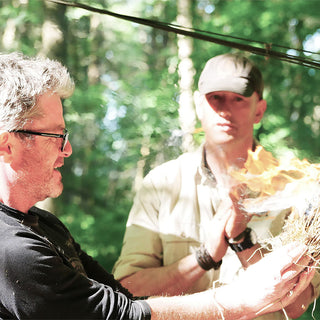
Firelighting Skills
Woodland Ways Bushcraft Weekend
Firelighting Skills
Woodland Ways Bushcraft Weekend
Preparing the evening meal
Woodland Ways Bushcraft Weekend
Preparing the evening meal

Woodland Ways Bushcraft Weekend
You will chose from a thermal A-Frame, Artic Lean-to or a variant of either, built with your own hands.
Woodland Ways Bushcraft Weekend
You will chose from a thermal A-Frame, Artic Lean-to or a variant of either, built with your own hands.
The Experience
Friday: Arrival & Woodland Immersion
Your experience begins in our private car park before we transition on foot into exclusive woodland estates that have no public access. From this point onwards, the pace slows and the outside world recedes, replaced by calm, space, and immersion in nature.
You are welcomed by our instructors before a comprehensive safety briefing and outline of the weekend ahead. With expectations set and excitement building, you shoulder your kit and walk into the woodland. Along the way, instructors begin interpreting the landscape—subtly introducing ecological relationships, resource indicators, and natural patterns that will underpin the rest of the course.
Camp Orientation & Tool Use - On arrival at the expedition‑style woodland camp, you are introduced to the course structure, communal resources, and specialist equipment. Time is taken to ensure you feel comfortable, grounded, and fully settled in your surroundings.
We then establish one of the most important foundations of bushcraft: tool use. Under close supervision, instructors demonstrate safe, efficient, and controlled techniques for knives and saws, including their use on a sawhorse with a bowsaw.
Each participant is issued with a Mora Companion bushcraft knife and a Bahco Laplander folding saw for the duration of the course. These tools are used extensively throughout the weekend, reinforcing confidence, competence, and respect for edged tools.
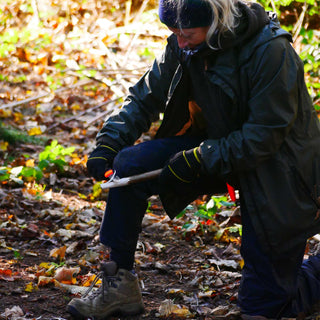
Woodland Craft & Material Processing - You will learn how to identify, select, and sustainably harvest woodland materials, understanding grain structure, compression and tension in wood, and how to process it efficiently. This knowledge is immediately applied through a practical craft project that is needed by Saturday lunchtime.
Techniques covered include: - Bevelling, shaving, pointing, batoning, splitting, and truncating - Limbing and controlled pruning cuts - Advanced knife grips and methods including chest lever, reinforced grips, rose cuts, knee bracing, stop cuts, and reverse grips.
Through this process, you develop not just technical skill, but an appreciation of craftsmanship and efficiency.
Later in the weekend there is a dedicated session which focuses on tool care, sharpening, selection, and legal responsibility, ensuring you leave with the knowledge to invest wisely in your own equipment and use it correctly and safely.
Fire, Shelter & Evening Dining - As the fire is established, attention turns to shelter. For the first evening, you learn the advantages of rapid‑deployment shelters, setting up a tarp or basha to provide immediate protection while maintaining adaptability.
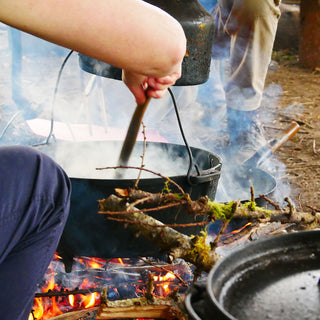
Dinner is then prepared. While this is not a subsistence course, meals are deeply rooted in traditional bushcraft practice. Evening meals typically feature carefully sourced feathered game such as pigeon, partridge, or pheasant, with thoughtfully prepared dietary alternatives available when requested.
Instructors guide you through preparation, cooking methods, and fire management, with the opportunity for hands‑on involvement at every stage. If conditions allow, the evening concludes with a refined session on celestial navigation, examining constellations and natural orientation using the night sky.
Saturday: Refinement & Depth
Natural Shelter Theory & Construction
Saturday begins with breakfast and an in‑depth exploration of shelter theory, examining shelter as a system of thermal regulation, weather protection, and psychological comfort.
You will gain a clear understanding of: - Site selection for safety and efficiency - Orientation relative to wind, terrain, and heat loss - Frame construction without cordage or mechanical fixings - Rafter geometry, thatching materials, and structural integrity
This theory is then applied through the construction of a more permanent woodland debris shelter. You may choose from designs such as a thermal A‑frame, Arctic lean‑to, or a refined hybrid based on weather conditions and other requirements.
Cooking Over a Fire & Traditional Food Skills
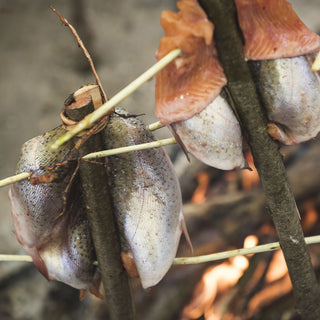
Lunch centres on the preparation and cooking of fish—typically rainbow trout—using a traditional Native American technique known as ponassing. You will gut, fillet, and cook the fish directly over the fire without modern cookware, using the carving project set for you, reinforcing efficiency and elegance in simple systems.
The afternoon continues with mammal processing, typically rabbit, before transitioning into a guided foraging and ethnobotany walk. This session reframes the woodland as a sophisticated living resource, revealing food, medicine, fibres, and navigational indicators embedded in the landscape.
Instruction covers: - Personal safety, tolerance, and risk awareness - Legal frameworks including the Wildlife and Countryside Act 1981 - Sustainable harvesting principles and the Forager’s Code - Historical, contemporary, and folkloric uses of plants.
Rather than relying on just visual familiarity for identification, this session develops sensory literacy—using touch, scent, taste, sound, and environmental context to build lasting confidence and understanding.
Natural Navigation & Quiet Craft
Natural navigation follows, drawing on landscape features, plant behaviour, and environmental patterns. Back at camp, you are introduced to green‑wood carving through the creation of a simple spatula, before enjoying quiet, reflective time carving at your shelter—a moment many participants describe as one of the most grounding parts of the weekend.
As the evening meal cooks, we explore knife and axe selection at a professional level, including blade geometry, bevel types, sharpening systems, and legal responsibilities. With the day complete, you retire to your shelters for a restful night.
Sunday: Fire & Water, essential skills for wilderness adventures
The final morning begins with breakfast and the preparation of individual unleavened damper breads, cooked around the fire. We explore its historical roots, terminology, and nutritional value as a reliable wilderness staple.
Firecraft forms the centrepiece of the final sessions. You are guided through humanity’s relationship with fire—from early friction methods and mineral‑based sparks to modern ferrocerium systems. Emphasis is placed on hands-on time and expert input from the instructors to help refine and improve your techniques.
You will learn: - Wood selection and component preparation - Body positioning and efficient movement - Ember formation and tinder management - Fire lays for specific purposes, including huntsman and Siberian styles - Extinguishing and site restoration in line with Leave No Trace principles.
The course concludes with an exploration of water procurement and treatment. Drawing on genuine expedition experience across varied and extreme environments; instructors cover sourcing, collection, filtration, and purification—grounded in reality rather than theory.
The Woodland Ways Standard
This course is intentionally challenging, deeply engaging, and expertly supported. It is not an endurance test, and you will never be asked to do anything you are uncomfortable with. Instruction is calm, professional, and attentive at all times.
Participants frequently arrive believing they understand the fundamentals, only to discover a level of depth, precision, and insight that exceeds expectations. This is not a basic introduction—it is a professionally delivered foundation.
No prior experience is required. Most participants attend alone or in pairs, and we are proud of the inclusive, respectful atmosphere fostered by our diverse instructional team and client base.
Independent reviews on Google and Trustpilot consistently reflect why Woodland Ways is recognised as the market leader in bushcraft and survival education.